Private Pilot License Training

Your First Step Into Aviation

A Private Pilot License (PPL) is the foundation of your aviation journey — giving you the freedom to fly for personal use and opening the door to a professional pilot career. It is the first step toward becoming a pilot, equipping you with the essential skills and knowledge to operate an aircraft safely and confidently.

At Desert Aviation Academy, we offer professional Private Pilot License training in Namibia for those starting their aviation journey. Whether your goal is recreational flying, exploring Namibia from above, or progressing toward a Commercial Pilot License, our program combines theory and practical training to develop confident, capable pilots.

Entry Requirements & Application Process

Student Pilot License (SPL)

To apply you must:

Be at least 16 years of age

Hold a valid Class I or Class II Aviation Medical Certificate)

Be proficient in English (the international language of aviation)

Have no specific subject requirements, although Mathematics and Science may be beneficial

Required Documents:

Two passport photos for license endorsement

Certified copy of ID (Namibian citizens)

Certified copy of passport (foreign students)

Valid certified copy of a study visa (foreign students)

Completed Desert Aviation Academy enrolment form

Latest Grade 10, 11, or 12 Certificate

Desert Aviation Academy can assist with study visa applications where required.

PPL Training Structure

Theoretical PPL Training

Theoretical knowledge forms the foundation of safe and competent flying. It equips pilots with an understanding of aircraft systems, weather, navigation, and decision-making required for safe flight operations.
Students are required to pass 8 subjects, each with a minimum pass mark of 75%, written online at the Namibia Civil Aviation Authority:
  • Principles of Flight
  • Air Law
  • Human Performance
  • Meteorology
  • Aircraft Technical & General
  • Flight Performance & Planning
  • Navigation
  • Restricted Radio

Practical PPL Flight Training

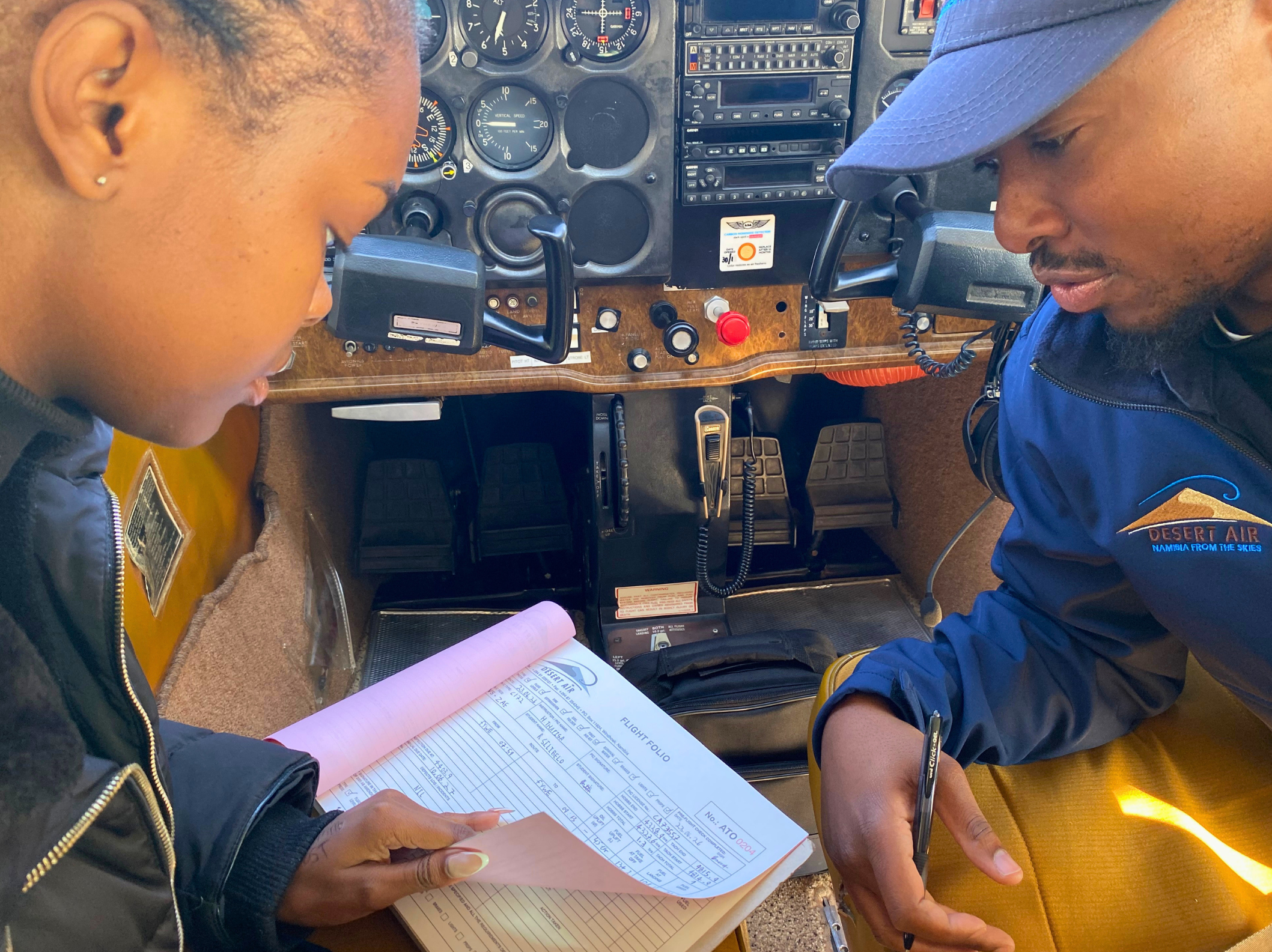
Practical training focuses on developing hands-on flying skills. During your training, you will learn pre- and post-flight procedures, take-offs and landings, flight planning, navigation, and weather interpretation. You will also become familiar with aircraft instruments and communication systems while developing core flying skills and applying essential safety and emergency procedures with confidence
Flight Training Breakdown
  • ± 30 hours of air exercise briefings (classroom-based)
  • Minimum 25 hours dual flight training, including at least 5 hours cross-country navigation
  • Minimum 10 hours solo flight training, including at least 5 hours solo cross-country navigation
  • 5 hours Basic Instrument Flight (IF) simulator training
  • Final Practical Flight and Navigation Skills Test

PPL Test

After completing all theoretical examinations and practical flight requirements, students must pass a PPL Skills Test.

  • Conducted by a Designated Flight Examiner
  • Assesses professional standards, aircraft handling, and operational decision-making